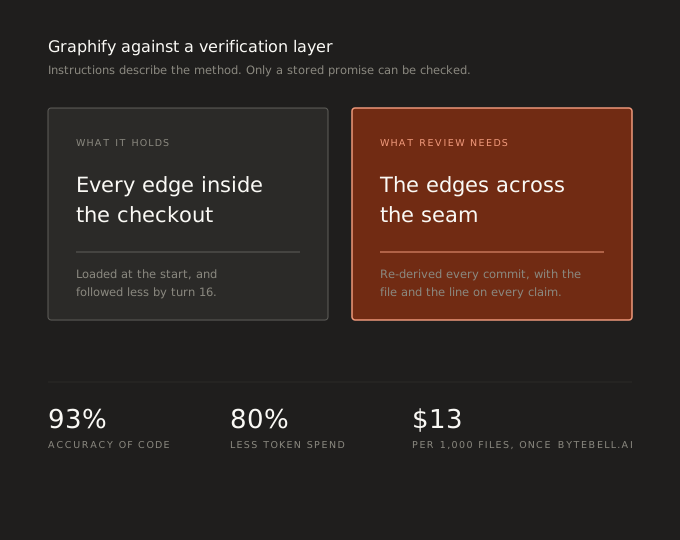
Graphify Builds a Beautiful Graph of One Repository. Production Breaks Between Them
Graphify does something worth having a lot of time for. It parses your codebase on device using 36 tree sitter grammars, produces a graph of typed nodes with provenance tagged edges, writes it to a file on your disk rather than rows in somebody’s hosted index, and serves it to Claude Code, Cursor, Codex and Gemini CLI over MCP with 10 tools. Apache 2.0, no vector store, no telemetry, nothing sent anywhere.
That is a clean design and the privacy position is genuinely better than most of the category. If you work in one repository and you want your agent to stop grepping, this is a good afternoon’s work with a real payoff.
The problem starts the moment your organisation has more than one repository, and it is not a problem more parsing solves.
What the graph knows and where it ends
A deterministic AST parse produces exactly what a parser can see. Which function calls which, what imports what, what type is declared where, and how the symbols in this checkout relate to each other. Provenance tagged edges are a nice touch, because you can trace any edge back to the line that produced it.
The boundary is the checkout. A parser resolves references it can reach on the filesystem in front of it. When your billing service publishes an event that a reporting service in another repository consumes, there is no edge to parse, because the two ends of that relationship were never in the same working directory. The graph is complete and correct, and it stops at a boundary the system does not respect.
You can point Graphify at several repositories and merge the graphs. What you get is several correct graphs sitting next to each other, still with no edge across the seam, because the seam is a runtime contract rather than a syntactic reference. Nothing in the parse can tell you that a mobile client decodes this payload strictly, so an added field fails to parse there and nowhere else in the estate.
Why that boundary is where the money is
Cross repository breakage is the specific failure mode that costs enterprises real money, and it is common enough to be routine. A team of four changes one repository, tests their own code, and does not test its effect on the rest of the system. Pushes to production keep failing and nobody can explain why, because every team’s tests passed.
Agents made this worse by an order of magnitude. Volume of change went up sharply and the number of people able to review it did not move at all. Stripe’s internal agent system was merging well over 1,000 AI written pull requests a week as of February 2026, and that number is not unusual any more at large companies.
There is a second thing a parser cannot reach, and the research is clear about its size. In the MSR 2026 dataset of agentic pull requests rejected by maintainers, only about 36% reflected a clear failure in the agent’s code. Another 31% were rejected because the change violated a workflow constraint or a decision the project had already taken, and that context does not live in the repository at all, let alone in the syntax tree.
So a parser based graph is complete about structure inside one boundary, and silent about intent and about everything across the boundary.
What we build instead
ByteBell is a verification layer generated on top of a codebase of any size below 10 million files, and the difference is what happens during indexing.
Cheap open source models read every file once. An agent detects the boundaries of classes, functions and every other language element, stores them separately, then analyses each one in the context of its file, its module, its repository, and across every repository we have indexed. That last clause is the whole point. The analysis is not scoped to a checkout, because the model is asked explicitly what depends on this element elsewhere in the organisation, and it answers from the other indexed repositories rather than from what the parser could reach.
For a single file the output includes what the module does, why it exists in business terms, what users lose if it fails, the capabilities it provides, its edge cases, the contracts it provides, its preconditions, and the places where its behaviour is genuinely undecided. All of it is plain English with the file and the line attached to every claim.
Here is what that produces in practice. Asked which files must change if the shape of a writer contract changes, the layer returned 32 impacted files across 4 repositories in 4 minutes 9 seconds, naming 3 teams, marking one file as a shared schema, one as will break, one as needs review, one as new work, and one as ask first because it belongs to billing. It also listed 2 things it would not guess, namely whether exports should count against the metered plan and whether row limits are enforced for each workspace separately. That run cost 30 for the same work by brute force.
A parser can produce the file list inside one repository. It cannot produce the team ownership, the will break against needs review distinction, or the honest statement that 2 decisions are undecided.
Then the direction reverses
Because the layer holds what each file promised, a proposed change can be compared against that promise rather than judged on its own. We trace what a change touches, generate tests for it, run them, and review each modified file against its indexed base rather than against what the diff says it changed. Collateral damage is checked across the other repositories that read the same helper before anyone approves. A full test generation and review pass came to 87,001 tokens at $0.11.
That is the step no graph of symbols performs, because verification requires a stored statement of intent to verify against.
The cost picture
Graphify is free and parses locally, which is a real advantage and not one to talk around. Ours costs about $13 per 1,000 files to index, once, with only what changes re-derived on each commit.
What the paid index buys is that the reasoning stops repeating. In a parser based flow the agent still has to read the actual code to work out what it means, so the expensive part happens on every question and the bill scales with codebase size and question count. Accuracy of code holds above 93% while token spend drops by roughly 80%, which is how the layer manages to decrease AI cost and raise correctness together rather than trading one against the other.
On privacy we are in the same place Graphify is, and for the same reason. Hosted, on dedicated hardware, or fully inside your own network, read only in all three, with your source never leaving your infrastructure on the second two. You bring your own model keys, including Anthropic, Gemini, OpenAI Codex, DeepSeek, Qwen, Z.ai or anything reachable through OpenRouter.
Where Graphify is the right tool
One repository, local only, no budget, and questions about structure rather than meaning. Deterministic parsing over 36 grammars with provenance on every edge is a better answer for that than anything statistical, and it will never hallucinate a relationship. The two also compose sensibly, since precise local structure and a derived cross repository specification are answering different questions.
The honest limitation
Deterministic parsing is the one place a tool like Graphify beats us permanently. A parser reads the compiler’s own view and cannot invent an edge, while a model derived index can be wrong about a relationship. We handle that by attaching a file and a line to every claim so any statement can be checked in about 10 seconds, and by re-deriving on every commit, though there is a window after a push where a claim can lag the branch.
We also do not cover every language. Mojo is not indexed today.
This is what ByteBell builds
Take the last incident where the breaking change was clean inside its own repository, and ask a single repository graph what the blast radius was. Whatever it returns is the shape of the boundary, and the thing that broke was on the other side of it.
ByteBell is the verifiable context layer for code. We run the LLM compiler pattern, a one time pass where a model reads every file and lowers it into a verifiable code IR capturing purpose, business context and cross repository relationships, on your own infrastructure through Docker, with your source never leaving your environment. Every engineer, on any copilot, queries the same representation through a single MCP url, and every agent edit is checked against it before it lands, using per file SHA-256 diffing so only what actually changed gets examined again. Across 46 Kubernetes ecosystem repositories and 150,000 files we measured roughly 10% higher accuracy at 70% lower cost, on about a fifth of the tokens.